

Australia, don’t conflate anti-Semitism with criticism of Israel
By Shahram Akbarzadeh
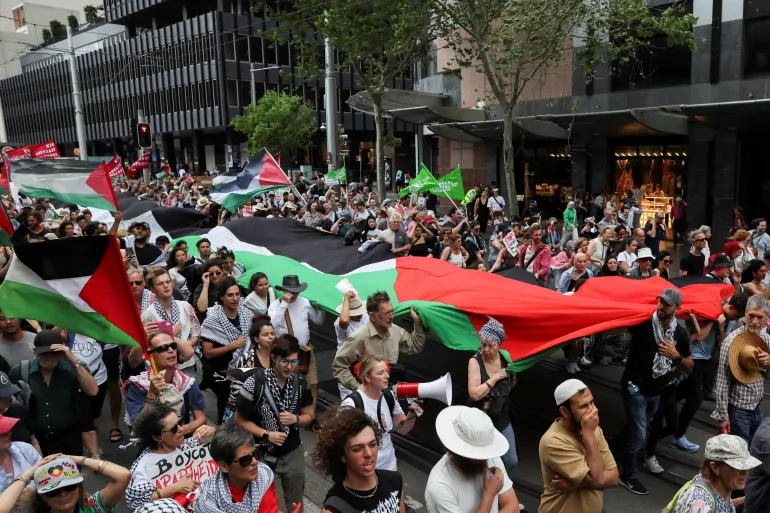
Suggestions that criticism of the State of Israel is anti-Semitic in Australia risk hardwiring a dangerous confusion. Questioning the behaviour of a foreign state is not the same as denigrating or attacking a people who may have links with that state. The State of Israel is represented by its embassy in Canberra, not by the Jewish community in our cities and suburbs.
But the knee-jerk reaction to the attack on a Jewish celebration in Sydney is solidifying that confusion. On December 14, 2025, as Jewish families gathered near Sydney’s Bondi Beach to celebrate Hanukkah, two gunmen opened fire, killing 15 people and injuring many others in one of the worst attacks in Australia’s history. In response, the federal government set up a Royal Commission on Antisemitism and Social Cohesion, led by former High Court justice Virginia Bell. On April 30, 2026, the commission delivered its interim report, raising serious concerns about how we define anti-Semitism.
The commission has adopted the International Holocaust Remembrance Alliance (IHRA) working definition of anti-Semitism. The IHRA offers examples that include criticism of Israel as evidence of anti-Semitism. But such a broad definition collapses critical commentary on Israel’s policy in Gaza, its treatment of Palestinians in the West Bank and Israeli officials’ dehumanising comments about Palestinians into a racist attack on Australia’s Jews. How does that make sense to anyone?
This is not an abstract question. The blurring of these categories acts as a brake on public debate. It narrows the range of permissible language used to describe Israel’s conduct in Gaza, where Australians have watched entire neighbourhoods destroyed and tens of thousands of civilians killed.
The official line from governments in relation to Israel is that Israel has a “right to exist” and an obligation to defend its citizens, which appears to give Israel carte blanche to decimate the entire Gaza Strip and kill tens of thousands of Palestinians. But no other state enjoys this exceptional treatment. No other state can do what it wishes simply because it has a “right to exist”. Australia has that right, but that right has never shielded governments in Canberra from fierce criticism, whether over First Nations dispossession, offshore detention or climate inaction. When Prime Minister Kevin Rudd apologised to the Stolen Generations in 2008 for the wrongs past governments had done to Aboriginal and Torres Strait Islander people, Australia’s legitimacy as a state was not under threat. Rudd was reflecting the public mood by distancing his government from the policies of the past. It was not seen as challenging Australia’s right to exist.
Yet in debates about Israel, the invocation of the “right to exist” and anti-Semitism operates as a conversation stopper. It closes the door to a frank discussion about the State of Israel and its behaviour. We cannot talk about occupation, apartheid and war crimes because that is anti-Semitic. This is a troubling precedent that insulates Israel from moral and political accountability.
The commission was established in response to a real and deeply upsetting surge in anti-Semitic violence. But its framework could cast suspicion on genuine inquiry into the behaviour of Israel. It entrenches a form of exceptionalism that actually weakens Australia’s democratic norms.
A liberal society must be able to draw a clear line: hatred, discrimination or violence against Jews is anti-Semitic and unacceptable; criticism of a foreign government is not.
There is also a cost to Jewish Australians when that line is blurred. Public debate routinely treats “the Jewish community” as a single, pro-Israel bloc, represented by a handful of bodies. This is simply not true. Many Australian Jews are alarmed to see the destruction of Gaza in their name. Some have mobilised against Israel’s actions.
To assume unanimous Jewish support for Israeli actions is to deny Jewish Australians their agency. Worse, it risks casting Jewish dissenters as inauthentic. If the policy settings shaped by this commission casts such voices as anti-Semitic, they will be erased twice over: excluded from the definition of the community and penalised for speakingup. This is silencing dissent, masquerading as protection.